Whenever money moves from one country to another, its value shifts along the way. A currency converter tells you what your money is worth in a different currency, so your decisions rest on facts instead of guesswork. Whether you are paying for an overseas course, collecting a freelance payment, or budgeting for a holiday, checking the rate first is the smartest habit you can build.
A dependable currency converter does more than simple multiplication. It gives you a fair reference price, helps you notice when a bank or exchange shop is charging too much, and makes planning far easier. This guide explains how exchange rates work, which conversions matter most to people in Pakistan, and how to keep more of your money on every transaction. You can also open our free currency converter beside this article and test the examples yourself.
What Is an Exchange Rate and Why Does It Change?
An exchange rate is the price of one currency measured in another. If USD to PKR stands at 280, one US dollar costs 280 Pakistani rupees. The same idea applies to euros, pounds, dirhams, and every other currency.
These prices never stay still. Millions of traders, businesses, and banks buy and sell currencies all day, and their activity moves the rates. Several forces play a role:
- Interest rates: When a country offers higher returns, investors are drawn to its currency, which can make it stronger.
- Inflation: If prices rise fast inside a country, its currency tends to lose purchasing power over time.
- Trade balance: A country that buys more from abroad than it sells needs extra foreign currency, which can put pressure on its own.
- News and politics: Elections, new policies, and international deals can change rates within hours.
That is why last week’s number may not match today’s, and why it pays to check before any important payment.
Mid-Market Rate vs. the Rate You Actually Get
The mid-market rate sits exactly between the price buyers will pay and the price sellers ask. Think of it as the neutral value of a currency, with no profit added by anyone in the middle.
At a bank, an exchange shop, or a payment app, you almost never receive this exact figure. Providers build in a margin, and that margin is how they earn. Sometimes it appears as a clear fee. Other times it hides inside a slightly weaker rate, which lets a service advertise “no fees” while still taking a share.
The difference between the neutral rate and the one you are offered is called the spread. A narrow spread is good news for you, while a wide spread means you are paying more than you think. Comparing the offer with the mid-market rate is the simplest way to see how much.
Most Searched Currency Pairs by Pakistani Users
Most people are not after general market data. They want one number for one purpose. These are the pairs Pakistani users look up most:
- USD to PKR: The most popular pair, used by freelancers, online sellers, students, and families receiving remittances.
- EUR to PKR: Handy for travel, education, and business linked to Europe.
- GBP to PKR: Checked by people with relatives or jobs in the United Kingdom.
- AED to PKR: Very common among workers in the UAE who send money home every month.
- SAR to PKR: Important for Umrah and Hajj budgeting and for workers in Saudi Arabia.
- CAD to PKR and AUD to PKR: Popular with students and families connected to Canada and Australia.
Checking the dollar rate today before you withdraw, send, or invoice can help you pick a better moment, especially when the amount is large.
How to Convert Currency Step by Step
Converting money online takes less than a minute:
- Type the amount you want to convert.
- Pick the currency you currently hold, such as USD.
- Pick the currency you want, such as PKR.
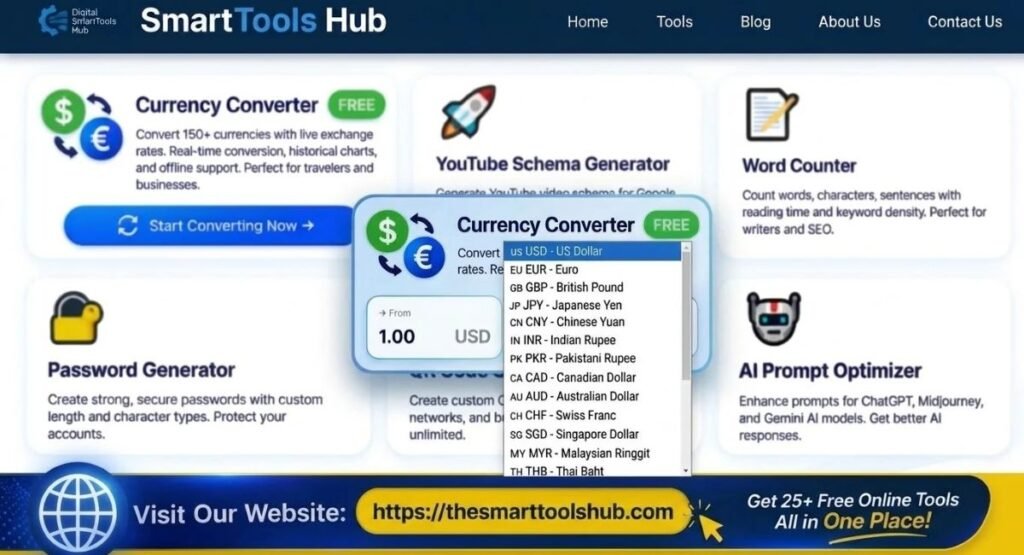
- Read the result and note when the rate was last refreshed.
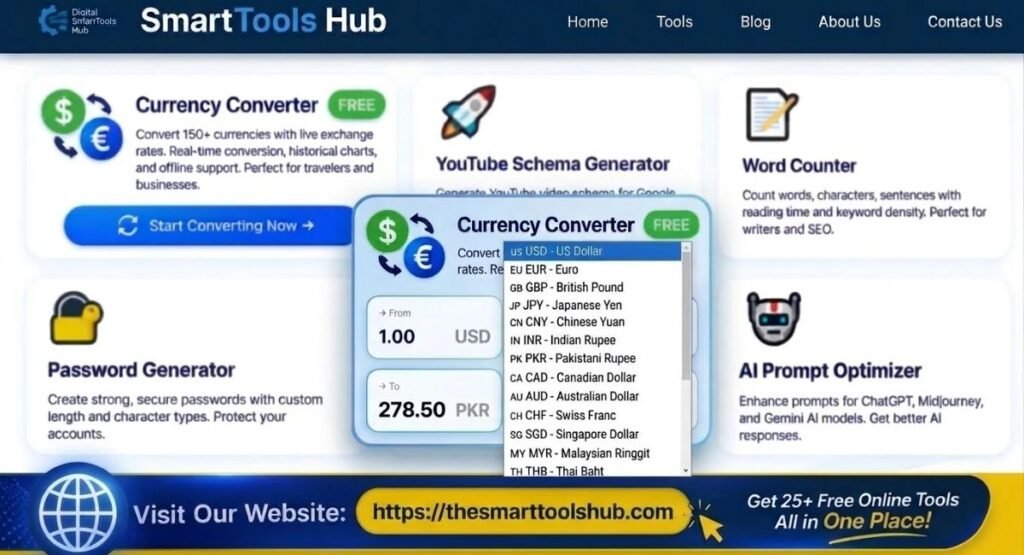
The last step is the one people skip, yet it matters. In busy markets, rates can move within minutes, so an old figure may mislead you. For a big payment, check again just before you confirm.
Understanding Fees and the Real Cost of Exchange
The rate is only part of the picture. The true cost also includes whatever the provider charges. Fees usually take one of three forms:
- Flat fees: A fixed charge on every transaction, whatever the size.
- Percentage fees: A slice of the amount you convert.
- Built-in margins: A weaker rate that quietly reduces what you receive.
Flat fees hurt small transfers the most, because a fixed charge can swallow a big share of a small amount while barely touching a large one. Percentage fees work the other way around. So the cheapest option depends on how much you are sending.
To compare services fairly, work out the final amount you will actually receive:
(Amount × Rate) − Fees = Net Amount Received
Do this calculation for each provider, and the best deal becomes clear.
Common Mistakes When Exchanging Money
Many people lose money without realizing it. Watch for these errors:
Taking the first offer. Banks and exchange companies quote different rates on the same day. Comparing two or three can save a noticeable amount.
Exchanging at the airport. Airport counters know travelers are short on time, and their rates often show it. Change only a small amount for immediate needs and handle the rest elsewhere.
Trusting “zero fee” claims. A provider may charge nothing upfront but offer a poor rate. Judge the final amount, not the slogan.
Ignoring timing. Converting in a hurry without looking at recent movement can leave you regretting it if the rate improves the next day.
Dealing with unlicensed sellers. A slightly better rate is not worth the danger of fraud or counterfeit notes. Stick to licensed banks and registered exchange companies.
Practical Tips for Getting a Better Rate
A few simple habits improve your results every time:
- Compare any offer with the mid-market rate before you agree.
- Combine small exchanges into one larger transaction to avoid repeated fees.
- Watch the rate for several days before a major transfer so you know its normal range.
- Ask the provider for the final amount in rupees, not just the quoted rate.
- When traveling, compare cash exchange with card payments and ATM withdrawals, and check your bank’s foreign transaction charges first.
- Keep a record of past rates so you can spot patterns and plan regular transfers more wisely.
Why Exchange Rates Matter for Freelancers and Students
Freelancers often earn in dollars but pay their bills in rupees. A small move in USD to PKR can change monthly income noticeably. Experienced freelancers follow the rate, choose payment platforms with reasonable fees, and avoid withdrawing at a poor moment whenever possible.
Students abroad face the reverse situation. Tuition and living costs are in foreign currency, while family savings are in rupees. Watching rates regularly helps families choose a good time to send money and helps students plan rent, food, and travel more accurately.
Smart Money Habits for Travelers and Overseas Workers
Travelers should convert their trip budget into rupees before leaving. Knowing roughly what a hotel, meal, or taxi costs at home-currency prices prevents unpleasant surprises when the card statement arrives.
Overseas workers who send money home each month benefit from consistency. Compare a few remittance options, see which one delivers the most rupees for the same amount, and stay with the best performer. Over a year, even a small gain per transfer becomes a real saving for the family.
Frequently Asked Questions
How often do exchange rates change?
They move constantly while markets are open. For anything important, check the latest figure right before you convert.
Why is my bank’s rate different from the online rate?
Banks add a margin to cover costs and profit, so their rate is usually less favorable than the mid-market rate.
Is it better to exchange money before a trip or after arriving?
There is no single answer. Compare rates and fees in both places, and avoid airport counters when you can.
Can I check rates for any currency?
Yes. You can look up major pairs like USD and EUR as well as local favorites such as PKR, AED, and SAR.
Does the rate I see online match what I will receive?
Usually not exactly. The online figure is a reference point, and your final amount depends on the provider’s margin and fees.
Conclusion
Exchange rates affect freelancers, students, travelers, and families who rely on money from abroad. Once you understand how rates move, what the spread means, and how fees reduce your final amount, you lose far less on every transaction. Compare offers, check the update time, avoid unlicensed sellers, and always calculate the net amount before you confirm.
Before your next payment, transfer, or trip, check the latest numbers with our currency converter and compare them with what your provider offers. A minute of checking can save you much more than it costs.